AI Conversation
explicar los casos de factoreo

Factoring, or "factoreo," can be seen as a mathematical puzzle where you break down expressions into simpler components. A fun fact is that it's like reverse multiplication, and mastering it can help solve complex algebraic equations more easily, much like unlocking a secret code!
https://www.youtube.com/watch?v=RwL1I60K6GE
diferencia de cuadrados
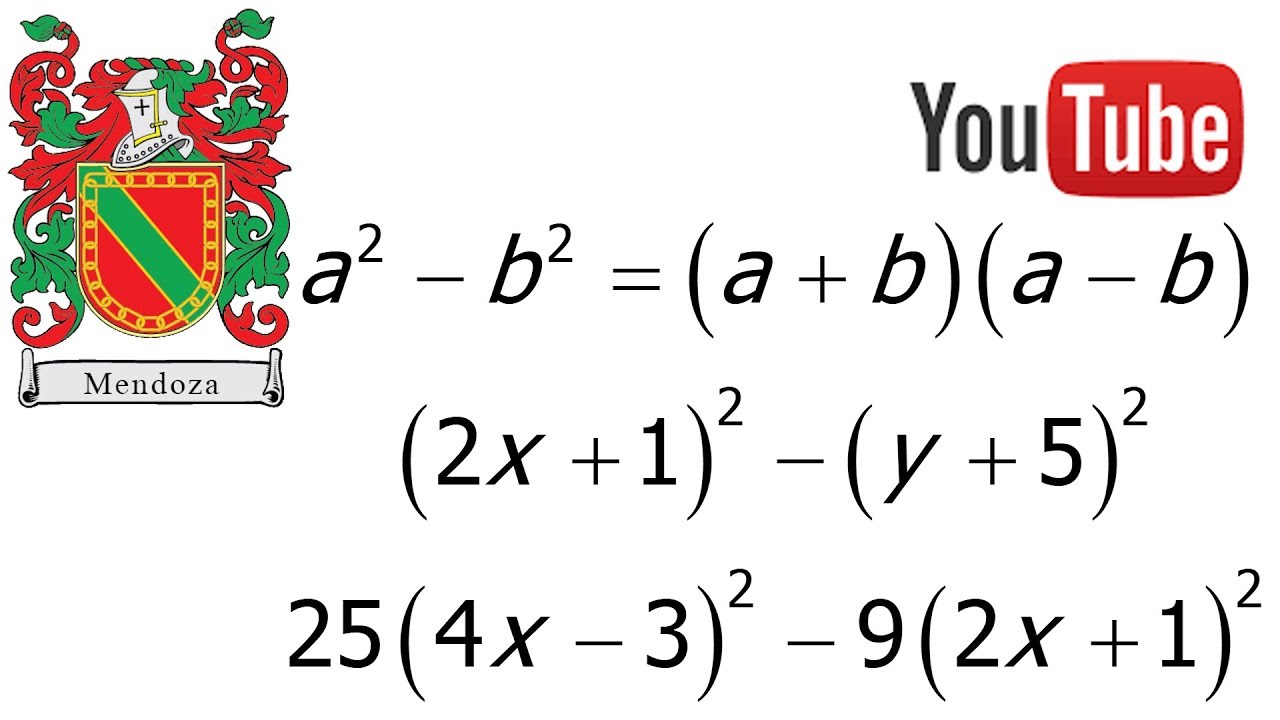
https://www.youtube.com/watch?v=esbREDCXTpM
La "diferencia de cuadrados" es un caso de factoreo que se aplica a expresiones de la forma \(a^2 - b^2\). Se descompone como \((a + b)(a - b)\). Este método simplifica el proceso de factorización al identificar términos cuadrados perfectos y su diferencia, facilitando la resolución de ecuaciones algebraicas.
factor común

https://www.youtube.com/watch?v=BygK11QxQnA
El factor común es una técnica de factoreo que consiste en identificar y extraer el mayor factor común de los términos de una expresión algebraica. Simplifica la expresión al dividir cada término por este factor, facilitando la resolución de ecuaciones y el análisis de polinomios en problemas matemáticos.
trinomio cuadrado perfecto
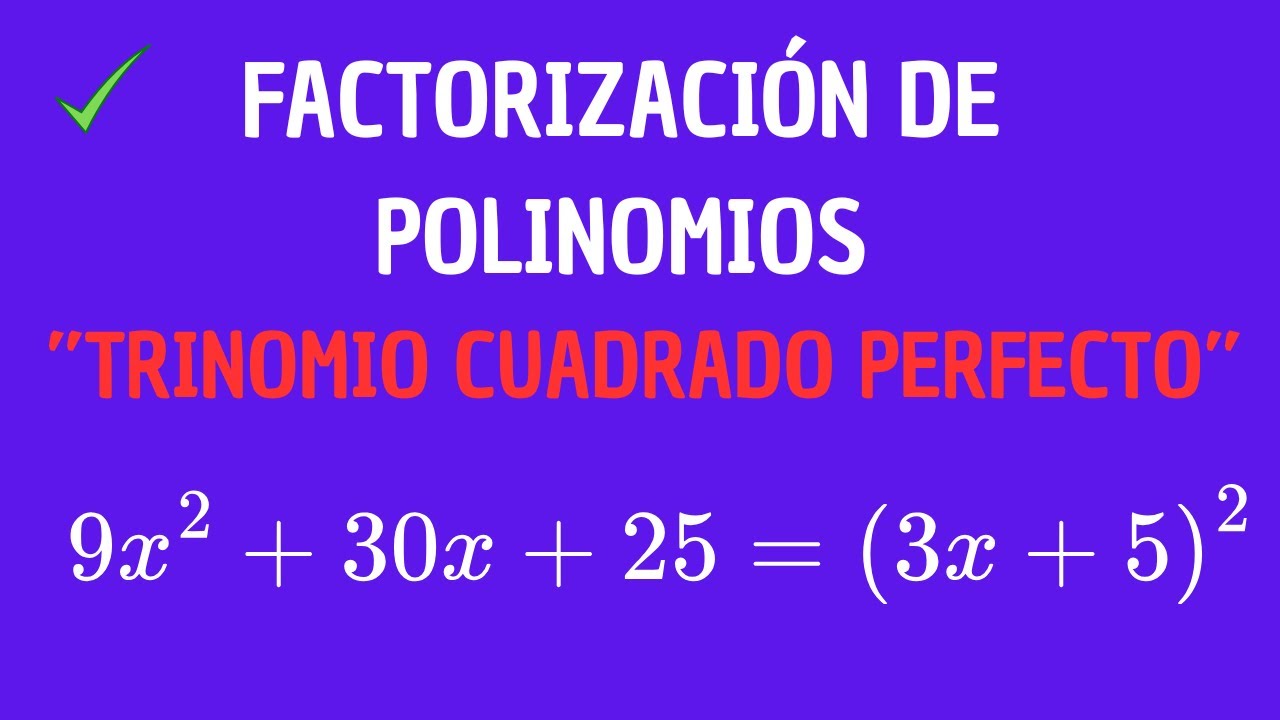
https://www.youtube.com/watch?v=TKo7NtIilWM
El trinomio cuadrado perfecto es un caso de factoreo donde una expresión de la forma \(a^2 + 2ab + b^2\) se factoriza como \((a + b)^2\). Reconocer este patrón simplifica la factorización al identificar los términos cuadrados y el doble producto, facilitando la resolución de ecuaciones algebraicas.
suma o diferencia de cubos
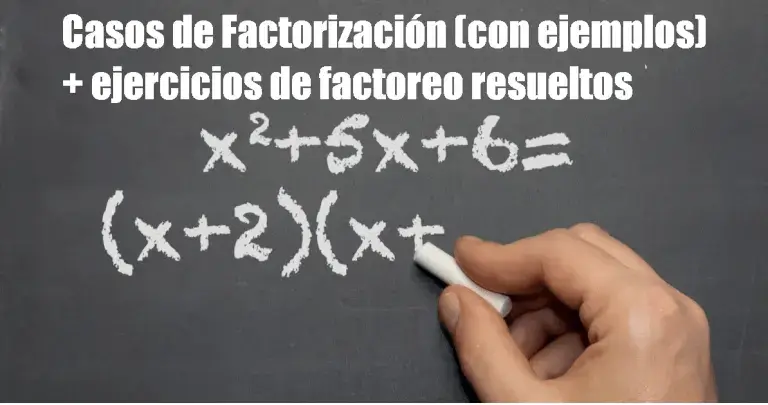
https://www.youtube.com/watch?v=X9DT2c1u_GU
La suma o diferencia de cubos es un caso de factoreo que se aplica a expresiones de la forma \(a^3 + b^3\) o \(a^3 - b^3\). Se factorizan como \((a + b)(a^2 - ab + b^2)\) y \((a - b)(a^2 + ab + b^2)\), respectivamente, simplificando la expresión original.
agrupación
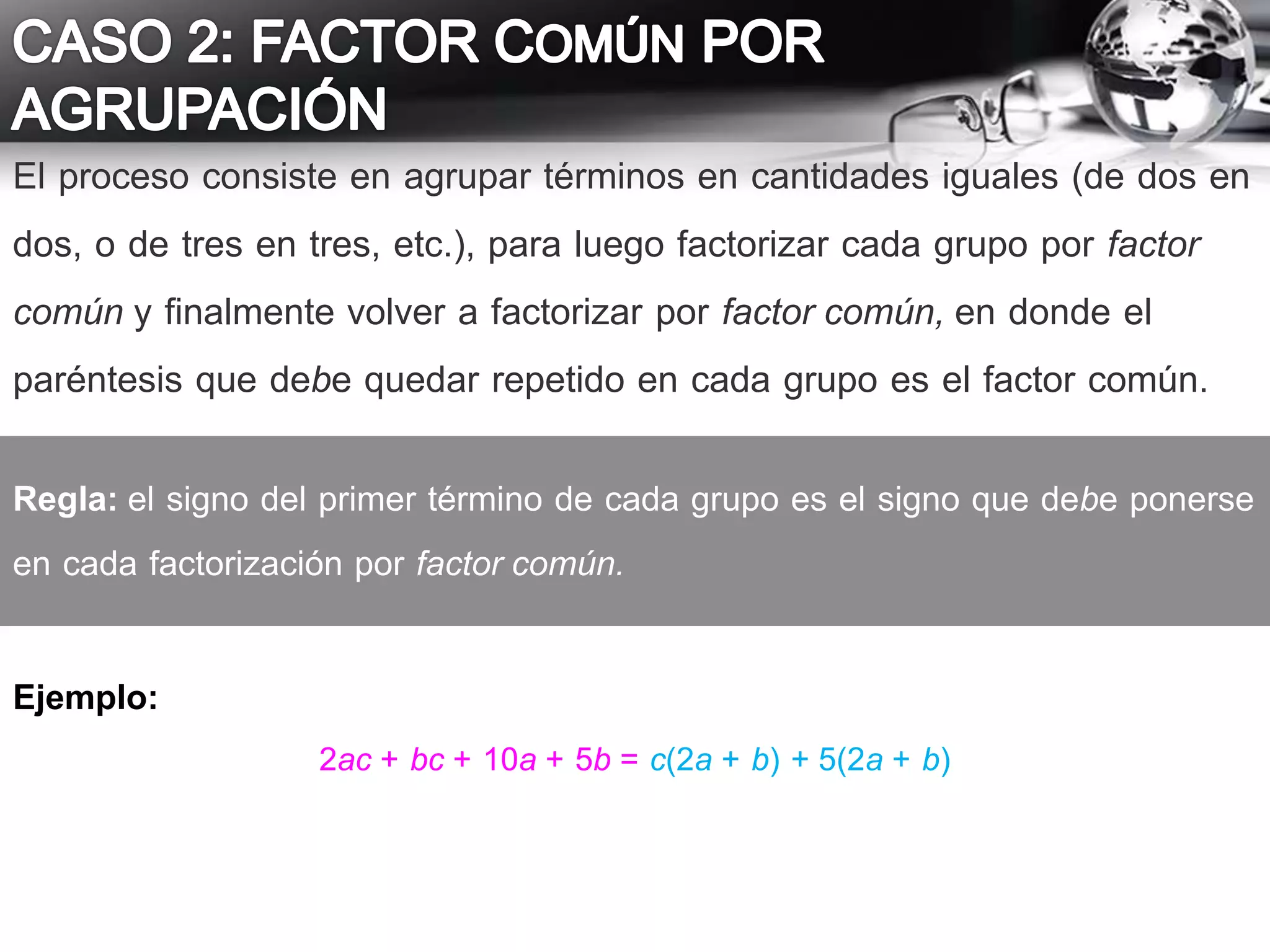
https://www.youtube.com/watch?v=zWVHT7z3w0o
La agrupación es un método de factoreo que implica reorganizar y agrupar términos en una expresión algebraica para facilitar su factorización. Se utiliza cuando los términos no tienen un factor común evidente. Al agrupar estratégicamente, se pueden extraer factores comunes de cada grupo, simplificando la expresión original.
polinomios de grado superior
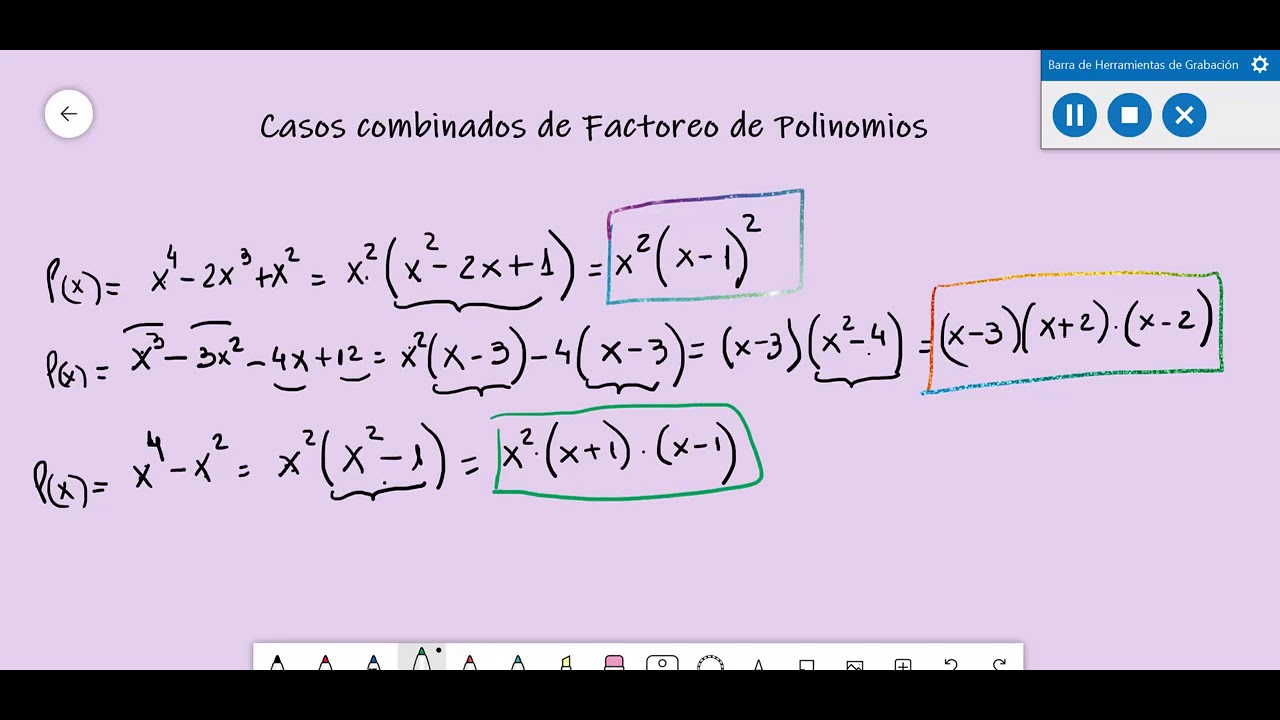
https://www.youtube.com/watch?v=X__hA6i6Ykk
Los polinomios de grado superior se pueden factorizar utilizando varios métodos, como el factor común, la diferencia de cuadrados, el trinomio cuadrado perfecto y el agrupamiento. Estos casos de factoreo simplifican la expresión polinómica, permitiendo resolver ecuaciones y encontrar raíces de manera más eficiente.
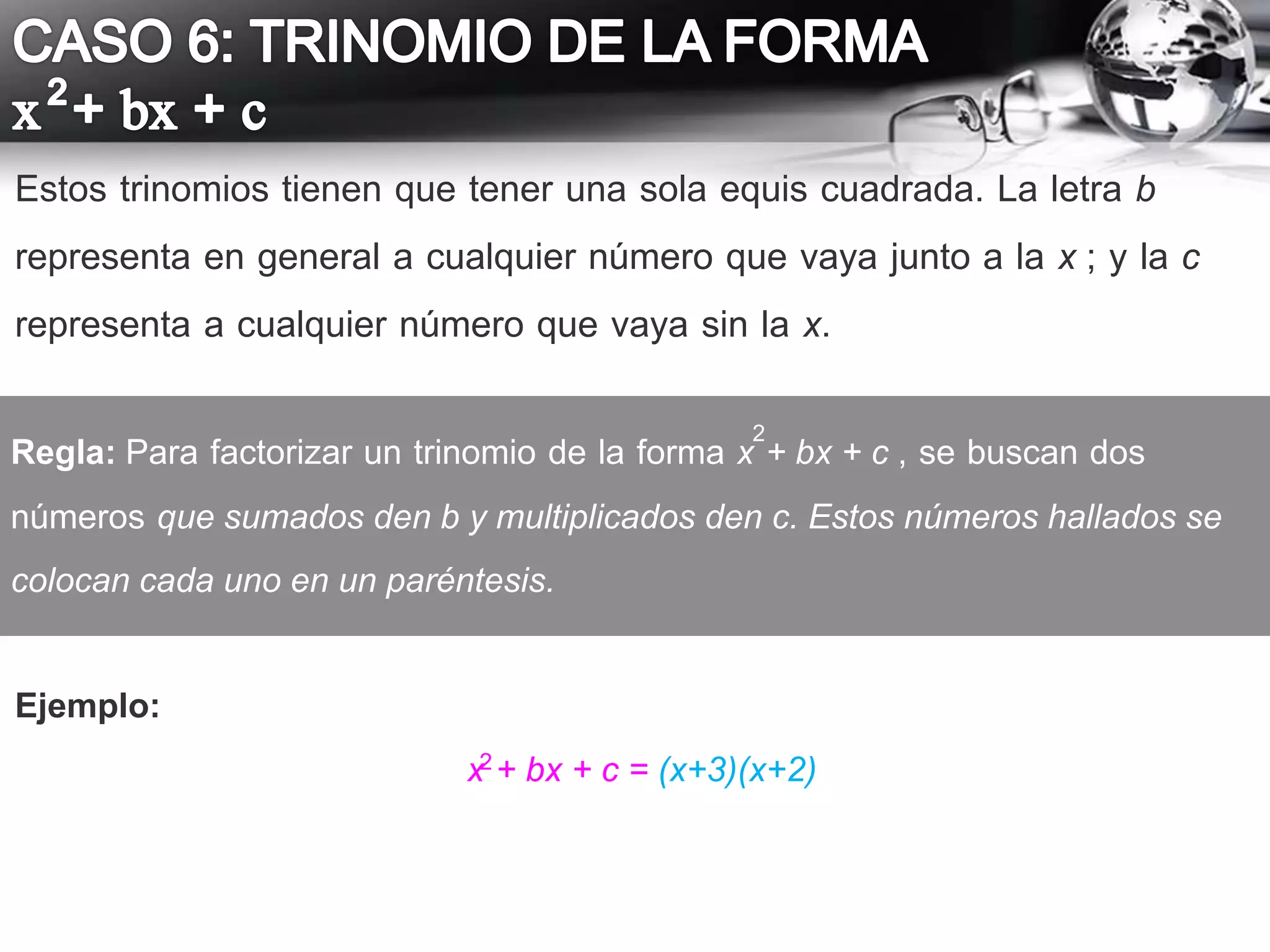
trinomio de la forma ax² + bx + c

https://www.youtube.com/watch?v=xZHGl-RUqHs
El trinomio de la forma ax² + bx + c se factoriza buscando dos números que multiplicados den ac y sumados den b. Se reescribe el término medio usando estos números, se agrupan términos y se aplica factoreo por agrupación, simplificando el trinomio en un producto de binomios.
identidades algebraicas
https://www.youtube.com/watch?v=a8CUEopWCN0
Identidades algebraicas son expresiones equivalentes que facilitan el proceso de factoreo. Incluyen casos como el cuadrado de binomios, diferencia de cuadrados, y suma y diferencia de cubos. Estas identidades permiten descomponer polinomios en factores más simples, simplificando cálculos y resolviendo ecuaciones algebraicas de manera eficiente.
AI Report
Essay
**Explaining Factoring Cases in Finance**
Factoring is a financial transaction in which a business sells its accounts receivable to a third party, known as a factor, at a discount. This practice allows companies to obtain immediate cash flow, rather than waiting for customers to pay their invoices. There are several cases in which factoring is employed, each with distinct characteristics and implications for the businesses involved. This essay will explore three primary cases of factoring: recourse factoring, non-recourse factoring, and invoice discounting, highlighting the advantages and disadvantages associated with each.
The first case, recourse factoring, involves a situation where the business remains liable for the debts if the customer fails to pay. In this arrangement, the factor has the right to seek payment from the business for any unpaid invoices. This type of factoring is typically less expensive because the factor assumes a lower risk. However, the primary disadvantage is that businesses must still manage the risk of customer defaults. According to Smith and Smith (2020), "recourse factoring is often favored by companies with strong credit customers, as it allows them to maintain control over their receivables while gaining immediate liquidity" (p. 45).
On the other hand, non-recourse factoring allows businesses to transfer the risk of customer defaults to the factor. In this case, if the customer fails to pay the invoice, the factor absorbs the loss and cannot seek repayment from the business. This arrangement provides greater security for businesses, as they can be confident that their cash flow will not be jeopardized by customer defaults. However, non-recourse factoring typically comes at a higher cost due to the increased risk taken on by the factor (Johnson, 2021). As noted by Johnson (2021), "while non-recourse factoring helps businesses mitigate risk, it is crucial for companies to thoroughly vet the factor to ensure they are reputable and financially stable" (p. 102).
Lastly, invoice discounting is a form of factoring that differs from the previous two cases in that the business retains control of its sales ledger and continues to collect payments from customers. In this scenario, the factor provides an advance on the value of the invoices, which the business then repays, typically with interest, once the customers settle their accounts. This method allows businesses to maintain stronger relationships with their customers while still benefiting from improved cash flow. However, it requires a strong internal collections process, as the business must ensure that customers pay on time (Brown & Taylor, 2022). As highlighted by Brown and Taylor (2022), "invoice discounting is particularly advantageous for businesses that want to maintain direct customer relationships while accessing immediate liquidity" (p. 67).
In conclusion, factoring serves as a valuable financial tool for businesses seeking to improve cash flow and manage their accounts receivable. Each case of factoring—recourse, non-recourse, and invoice discounting—offers distinct benefits and risks. Businesses must carefully consider their financial situation, customer base, and risk tolerance when deciding which type of factoring to pursue. By understanding the nuances of these factoring cases, companies can make informed decisions that enhance their financial stability and growth.
### References
Brown, A., & Taylor, S. (2022). *Financial Strategies for Small Businesses*. New York, NY: Business Expert Press.
Johnson, R. (2021). *Understanding Factoring and Its Benefits*. Chicago, IL: Financial Publishing Co.
Smith, J., & Smith, L. (2020). *Cash Flow Management for Entrepreneurs*. Los Angeles, CA: Entrepreneur Press.
Lesson Plan
### Lesson Plan: Understanding Factoring Cases in Technical Vocational Education
#### Lesson Title: **Explaining Factoring Cases: How They Work and How They Are Maintained**
#### Grade Level: Technical Vocational Students (Approx. 11th-12th Grade)
#### Duration: 90 minutes
---
### Objectives:
By the end of this lesson, students will be able to:
1. Define what factoring cases are and their significance in technical vocations.
2. Explain the different types of factoring cases.
3. Demonstrate how factoring cases work through practical examples.
4. Understand the maintenance and best practices for keeping factoring cases functional.
### Materials Needed:
- Whiteboard and markers
- Projector and laptop for presentations
- Handouts with definitions, diagrams, and examples
- Factoring case models (if available) or sample materials
- Access to computers or tablets for research purposes
- Quiz sheets for assessment
### Lesson Outline:
#### Introduction (15 minutes)
1. **Warm-up Activity**:
- Start with a question: “What do you think of when you hear the term 'factoring'?”
- Engage students in a brief discussion to gauge prior knowledge.
2. **Objective Overview**:
- Clearly outline what students will learn and why it’s important for their vocational training.
#### Direct Instruction (30 minutes)
1. **Definition and Importance of Factoring Cases** (10 minutes)
- Explain what factoring cases are in the context of technical vocations.
- Discuss their applications in various fields (e.g., finance, manufacturing, etc.).
2. **Types of Factoring Cases** (10 minutes)
- Introduce the different types of factoring cases (e.g., invoice factoring, purchase order factoring).
- Provide real-world examples for each type.
3. **How Factoring Cases Work** (10 minutes)
- Explain the process of factoring, including the roles of the business, the factor, and the customer.
- Use diagrams to illustrate the flow of operations in factoring.
#### Group Activity (20 minutes)
1. **Case Study Analysis**:
- Divide students into small groups and assign each group a different type of factoring case.
- Provide them with a scenario to analyze and present:
- Identify the stakeholders involved.
- Discuss the pros and cons of the factoring case.
- Present their findings to the class.
#### Hands-On Practice (15 minutes)
1. **Factoring Case Simulation**:
- Use a mock business scenario where students must decide whether to use factoring.
- Students will calculate potential benefits and drawbacks, considering cash flow implications.
- Allow groups to present their calculations and reasoning.
#### Maintenance of Factoring Cases (5 minutes)
1. **Best Practices**:
- Discuss the importance of maintaining accurate records and communication with factors.
- Highlight common pitfalls in managing factoring cases and how to avoid them.
#### Assessment (5 minutes)
1. **Quiz**:
- Administer a short quiz covering key concepts from the lesson.
- Questions should include definitions, types of factoring, and maintenance practices.
#### Conclusion (5 minutes)
1. **Recap**:
- Summarize the key points discussed during the lesson.
- Encourage students to ask any remaining questions.
2. **Homework Assignment**:
- Assign students to write a one-page reflection on how they think factoring cases can impact a business’s financial health.
---
### Differentiation:
- **For Advanced Students**: Encourage them to explore more complex factoring scenarios or research current trends in factoring.
- **For Struggling Students**: Provide additional resources or one-on-one support to ensure understanding of basic concepts.
### Assessment & Evaluation:
- Student participation during discussions and group activities.
- Accuracy and depth of analysis in group presentations.
- Performance on the quiz.
- Quality of homework reflections.
---
This lesson plan aims to provide technical vocational students with a comprehensive understanding of factoring cases, equipping them with the knowledge to apply these concepts in their future careers.
Class Syllabus Outline
### Syllabus for "Understanding Factoring Cases" (Explaining Factoring Cases)
**Course Title:** Understanding Factoring Cases
**Course Code:** MATH-201
**Instructor:** [Instructor's Name]
**Contact Information:** [Instructor's Email]
**Office Hours:** [Days and Times]
**Course Description:**
This course provides a comprehensive exploration of factoring in algebra, focusing on various cases and methods. Students will learn to identify different types of polynomials and apply appropriate factoring techniques to simplify expressions and solve equations.
**Prerequisites:**
Completion of Algebra I or equivalent.
---
### Course Objectives:
By the end of this course, students will be able to:
1. Understand the fundamental concepts and definitions related to factoring.
2. Identify and apply various factoring methods, including:
- Factoring out the Greatest Common Factor (GCF)
- Factoring trinomials
- Factoring the difference of squares
- Factoring perfect square trinomials
- Factoring sum and difference of cubes
3. Solve polynomial equations using factoring techniques.
4. Analyze real-world applications of factoring.
---
### Course Outline:
**Week 1: Introduction to Factoring**
- Overview of polynomial expressions
- Importance and applications of factoring
**Week 2: Greatest Common Factor (GCF)**
- Definition and identification of GCF
- Techniques for factoring out the GCF from polynomial expressions
**Week 3: Factoring Trinomials**
- Structure of trinomials
- Methods for factoring trinomials (simple and complex)
**Week 4: Difference of Squares**
- Recognizing difference of squares
- Techniques for factoring expressions in the form a² - b²
**Week 5: Perfect Square Trinomials**
- Identifying perfect square trinomials
- Factoring techniques for perfect square trinomials
**Week 6: Sum and Difference of Cubes**
- Understanding the formulas for sum and difference of cubes
- Factoring applications
**Week 7: Factoring Completely**
- Strategies for combining different factoring techniques
- Practice with complex polynomials
**Week 8: Solving Polynomial Equations**
- Using factoring to solve polynomial equations
- Real-world applications and problem-solving
**Week 9: Applications of Factoring**
- Case studies and practical applications
- Discussion on the relevance of factoring in various fields
**Week 10: Review and Final Exam Preparation**
- Comprehensive review of all topics covered
- Practice problems and Q&A session
**Week 11: Final Exam**
- Assessment of understanding and application of factoring concepts
---
### Assessment & Grading:
- Homework Assignments: 30%
- Quizzes: 20%
- Class Participation: 10%
- Midterm Exam: 20%
- Final Exam: 20%
### Required Materials:
- Textbook: [Textbook Title and Author]
- Calculator (scientific or graphing)
- Notebook for notes and problem-solving
### Additional Resources:
- Online tutorials and videos
- Supplementary worksheets and practice problems
- Access to math tutoring services
---
### Course Policies:
- Attendance is mandatory; missed classes must be justified.
- Late assignments may incur a grade penalty unless prior arrangements are made.
- Academic integrity is expected; any form of cheating will not be tolerated.
---
**Note:** This syllabus is subject to change based on the needs of the class and the pace of instruction. Students will be notified of any changes in a timely manner.
Learning Objectives
Certainly! Here are some learning objectives for a course on explaining factoring cases, tailored for technical vocational students:
### Learning Objectives
1. **Understand the Concept of Factoring**:
- Explain the fundamental principles of factoring in mathematics, including its importance in simplifying algebraic expressions.
2. **Identify Different Types of Factoring**:
- Distinguish among various types of factoring methods, such as common factor extraction, grouping, difference of squares, and trinomial factoring.
3. **Apply Factoring Techniques**:
- Demonstrate the ability to apply different factoring techniques to solve quadratic equations and polynomial expressions accurately.
4. **Analyze Real-World Applications**:
- Evaluate real-world scenarios where factoring is applicable, such as in engineering, finance, and technology, to illustrate its practical importance.
5. **Develop Problem-Solving Skills**:
- Enhance problem-solving skills by working through a variety of factoring problems, both individually and in collaborative group settings.
6. **Utilize Technology in Factoring**:
- Use technological tools and software to assist in factoring complex expressions and verifying solutions.
7. **Communicate Mathematical Reasoning**:
- Effectively communicate the steps and reasoning involved in the factoring process through written and oral presentations.
8. **Prepare for Advanced Topics**:
- Lay the groundwork for more advanced mathematical concepts by mastering factoring techniques, preparing students for future studies in mathematics and related fields.
By the end of this course, students will have a solid understanding of factoring and will be equipped with the skills necessary to apply these techniques in various technical vocational contexts.
Quiz Questions
Certainly! Here are five multiple-choice questions related to explaining factoring cases, along with their answers:
### Question 1
What is the first step in factoring a polynomial expression?
A) Identify the roots
B) Find the greatest common factor (GCF)
C) Rewrite the expression
D) Apply the quadratic formula
**Answer:** B) Find the greatest common factor (GCF)
---
### Question 2
Which of the following is a correct factorization of the expression \(x^2 - 9\)?
A) \((x - 3)(x + 3)\)
B) \((x + 9)(x - 9)\)
C) \((x - 9)(x - 1)\)
D) \((x + 3)(x + 3)\)
**Answer:** A) \((x - 3)(x + 3)\)
---
### Question 3
In the expression \(x^2 + 5x + 6\), what are the factored terms?
A) \((x + 2)(x + 3)\)
B) \((x + 1)(x + 6)\)
C) \((x - 2)(x - 3)\)
D) \((x + 5)(x + 1)\)
**Answer:** A) \((x + 2)(x + 3)\)
---
### Question 4
What type of polynomial is represented by the expression \(ax^2 + bx + c\) when it can be factored into two binomials?
A) Linear
B) Quadratic
C) Cubic
D) Constant
**Answer:** B) Quadratic
---
### Question 5
When factoring the expression \(x^3 - 8\), which factoring technique is used?
A) Difference of squares
B) Perfect square trinomial
C) Sum of cubes
D) Difference of cubes
**Answer:** D) Difference of cubes
---
Feel free to use or modify these questions as needed!